

Discovery of specificity mechanisms within ubiquitination pathways

Latest research forms a framework to dissect specific ubiquitination events within cells
Research published in Nature Structure and Molecular Biology from Associate Professor Paul Elliott’s group uncovers how the ubiquitin-activating enzymes UBA1 and UBA6 distinguish between 29 E2 ubiquitin-conjugating enzymes to bring about ubiquitination.
Ubiquitination controls most eukaryotic processes through action of over a thousand proteins that add, recognise, or remove ubiquitin. But for any ubiquitination event to occur, ubiquitin must first be activated by dedicated E1 enzymes. Most animals have two E1 enzymes (UBA1 and UBA6) that transfer ubiquitin along an enzyme cascade to distinct subsets of E2 enzymes. Both UBA1 and UBA6 are essential for mammalian life yet what governs how UBA1 or UBA6 function with specific E2s is unclear. This cannot be predicted from sequence alone and even recent advances in structure prediction tools, such as AlphaFold, fail to capture the subtle structural constraints that enable specificity.
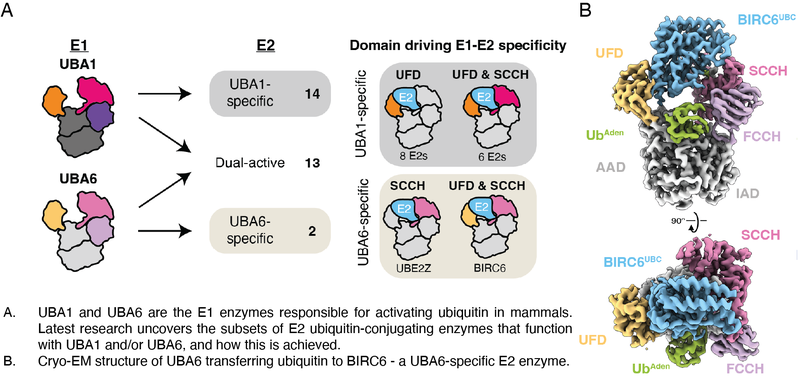
Through structural biology, biochemistry, and biophysics, the Elliott Lab has catalogued each of the 29 ubiquitin E2s for activity with UBA1 versus UBA6 and trapped E1s transferring ubiquitin onto E2s, leading to the development of a molecular rulebook that explains specificity. They teamed up with Associate Professor Peter Sarkies, also in the Department of Biochemistry, to assess tissue expression levels of E1s and E2s finding that E2 expression levels broadly correlated with their cognate E1. Focussing further on the E1-E2 pair of UBA6 – BIRC6, a 1MDa E2/E3 that inhibits cell death, they identify that BIRC6 gains priority to UBA6 over all other E2s through an unusual high affinity, yet uses a ubiquitin-mediated release mechanism to ensure it does not inhibit UBA6, underscoring the cellular requirement for functional UBA6 activity. Together, this work provides a powerful framework for dissecting distinct ubiquitination events within cells.

