

Understanding how bacteria transport folded proteins across cell membranes

This study provides an important foundation for understanding one of biology's most unusual transport systems and addresses a longstanding mystery in cell biology
Researchers from the Berks group at the Department of Biochemistry and colleagues in the Lea group at St. Jude Children's Research Hospital in the USA have captured the most detailed view yet of a remarkable transport system that moves folded proteins across cell membranes. The findings, published in Nature Microbiology, provide new insight into how the twin-arginine translocation (Tat) system recognises its cargo and prepares it for transport.
Most proteins are transported across cell membranes before they have folded into their final three-dimensional shape. The Tat system is unusual because it transports proteins that are already fully folded, essential for many key processes in bacteria and plant chloroplasts.
Using high-resolution cryo-electron microscopy, the researchers determined the structure of the Tat core complex from several bacterial species, including Escherichia coli. They also captured the complex interacting with a protein destined for transport, revealing how the machinery recognises a distinctive "twin-arginine" signal that directs proteins to the Tat pathway.
The study shows that the signal peptide binds to a component of the Tat transporter called TatC, while another component called TatB helps stabilise the interaction. Together, these proteins position the cargo for the next stage of transport across the membrane.
The researchers also discovered that the Tat complex locally thins the cell membrane by arranging several of its membrane-spanning helices at unusual angles. This thinning, when combined with the recruitment of additional Tat components, may temporarily destabilise the membrane to allow large, folded proteins to slip through.
Beyond answering fundamental questions about bacterial cell biology, the findings could have practical applications. As the Tat pathway is important for the survival or disease-causing ability of several bacterial pathogens, it is a potential target for the development of new antimicrobial drugs. The system is also of growing interest in biotechnology because of its ability to export folded proteins, a property that could be harnessed to improve the production of therapeutic proteins and industrial enzymes.
By revealing how the Tat machinery recognises its cargo and prepares proteins for transport, the study provides an important foundation for understanding one of biology's most unusual transport systems and opens new avenues for both basic research and applied science.
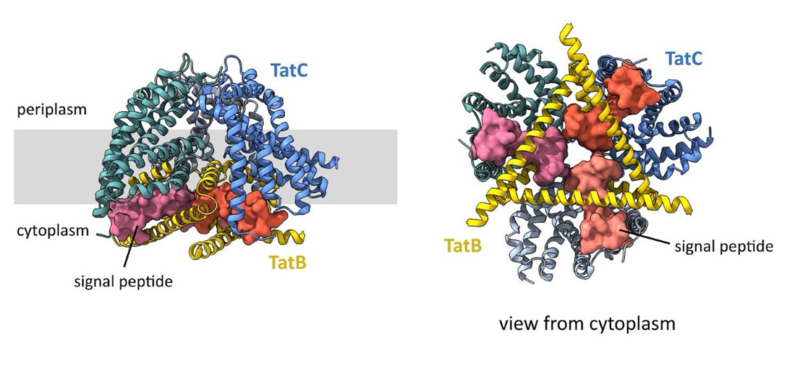
Structure of the signal peptide-bound E. coli Tat complex viewed from within the membrane (Left) or from the cytoplasm (Right). The TatB3C3 complex is shown in cartoons representation and the three signal peptides in space-filling representation.

